Honestly, I’m not super comfortable wearing and/or carrying signs wherever go (on foot or via public transport). For one thing, I’d say 90% of the people who go by either don’t see me (faces buried in their smartphones) or glance up and look quickly away, pretending that they don’t see the eccentric older lady plastered with signs. It is a strange feeling to be rendered invisible, to be deliberately not noticed, and I have a lot more sympathy now for the “regulars” in this category (such as the religious folk with their displays, but even more, the sign-carrying panhandlers and homeless people).
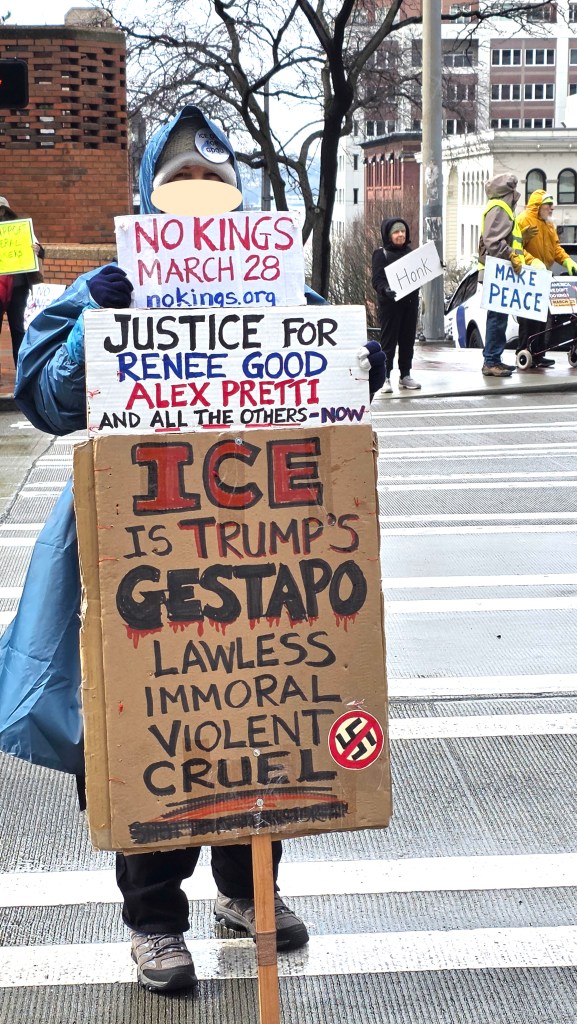
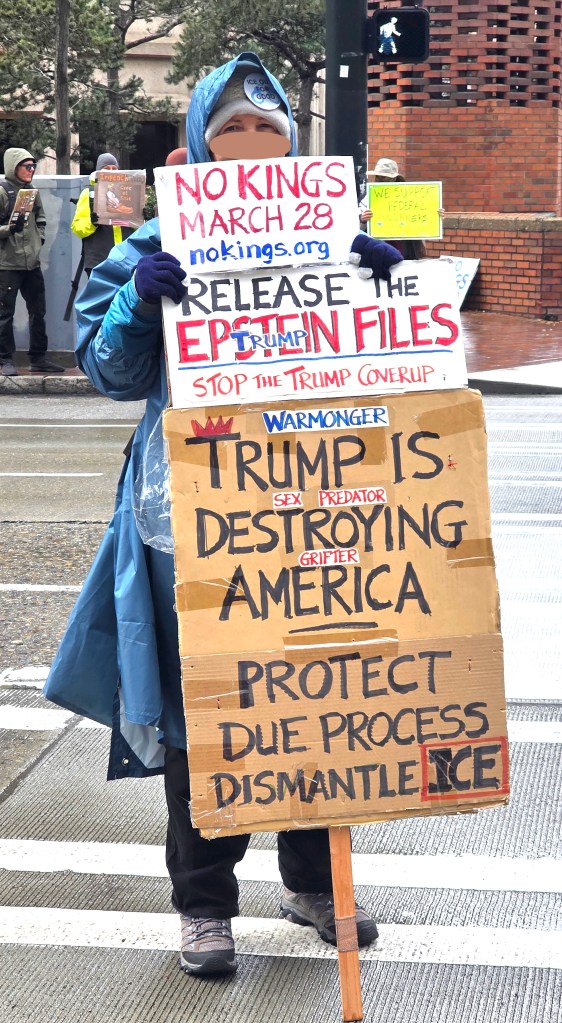
(I display big signs only at rallies, marches and sign-holding events.)
Of the 10% who do see me, and of the much smaller percentage who respond, 99% do so positively — a thumb’s-up, thanks, genuine smiles, nods, and (far more rarely) a brief conversation. I recognize that such positive responses would not be the norm in far too many places in the USA right now, alas, and I’m not sure I’d have the courage to do this in those places — it’s hard enough here! So why am I doing this?
A history buff
I was an early and voracious reader, and when I was a preteen many decades ago, I read my parents’ copy of William Shirer’s The Rise and Fall of the Third Reich. I was fascinated by the European theater of World War II (in part because of a popular TV show at the time, Combat!), but as I grew older, I wondered how it was that the German people chose to follow Hitler, chose to become accomplices in the horrors of the Holocaust.
My interest not only led me to read a lot of history about the Great Depression and World War II and the Cold War, but also to minor in social psychology when I went to university.
You probably already know that people are capable of doing things as part of a group that they would rarely if ever do as an individual, and “mob mentality” certainly played a role in the rise and violence of the Nazi movement. In addition, I learned about Stanley Milgram’s experiment — that is, people are very willing to obey authority, even if it means violating their own conscience and moral principles; further, Solomon Asch’s conformity experiments showed the enormous power of peer pressure. I have certainly seen these factors in play over the course of my life, and they are more chillingly relevant now than ever. (That said, many of the same aspects of human nature those studies revealed can also work for good purposes.)
In our time, in addition to all of its astonishing power for good, the rise of the internet and the Web has unleashed torrents of misinformation, deepfakes, fake “news,” and truly ghastly behavior from people who would never in their lives say and act that way IRL (in real life, in person). This type of anonymity has enabled individually tailored mob behavior — on steroids. And if you’re reading this, you probably all know about confirmation bias and about how readily people cling to lies regardless of facts and reason.
Living in Germany
One other enormous influence in my life that impels me to do what I can these days, including wearing and carrying signs, and trying to counter Trump’s lies and misinformation, is that for more than 10 years before the pandemic, I lived part of each year in Berlin, Germany. (I’d also lived and worked off and on near Heidelberg before that.) In Berlin in 2011, I visited the German History Museum’s first-ever, eye-opening exhibit about popular support for Adolf Hitler, and how quickly he moved to consolidate his power and eliminate his opponents after he became chancellor.
Reminders about the war and its aftermath were everywhere in the part of the former East Berlin where I lived, and for me, impossible to ignore.
There were many Stolpersteinen (“stumbling stones”) in my neighborhood — brass-topped memorial paving stones installed in the sidewalks in front of the homes and businesses of Holocaust victims. Dr. Landshut’s stone at right was one of the closest to where I lived, but I tried to notice all such stones when I would come across them.
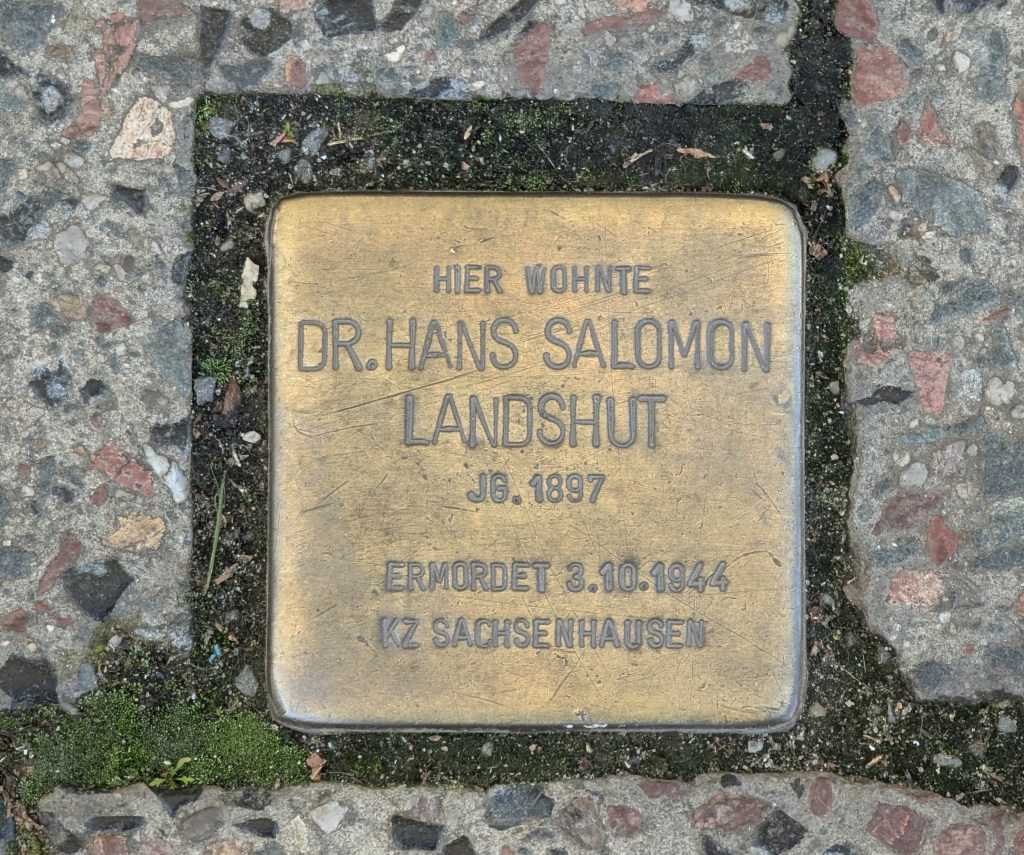
(I cannot help but wonder if and how we will end up memorializing the victims of this administration’s current cruel roundups and detentions and expulsions. I would much rather that we work together in every way that we can to stop it!)
I was a member of a high-level German choir in Berlin when Trump was elected the first time, and the day after the election, a fellow soprano came up to me at rehearsal and said (with genuine consternation), “Didn’t you Americans learn anything from what happened to us?!’
Alas, apparently not. (You can imagine how dumbfounded my German friends were when Trump won a second time.) Perhaps those of us who do try to learn from history will also be doomed to repeat it because too many people refuse to see the parallels, refuse to believe that fascism can happen here, that the members of authoritarian government can break their oaths of office with impunity, that the president is using his office to enrich himself and his pals. But here we are.
Mark Twain is credited with saying that “history doesn’t repeat itself, but it often rhymes” — and the poem being written and circulating now is horrifyingly familiar… and seemingly much louder and more widespread than before.
For me and mine, for you and yours, for America and for the world
Do I believe we are doomed? Only if we give up! Only if we stay on the sidelines, only if we avoid getting involved, only if we remain passive bystanders. That’s why I want to spread the word, to encourage people to stand up, to resist, to work together to course of history in a positive way. All of the lies and violence and chaos, all of the heedless destruction and pollution of our land and air and water, affects not just our country, but the entire world.
We must keep hope alive and do what we can — to save ourselves, our loved ones, our children and grandchildren, our friends, our neighbors, for those who are targets now, for all of us (even those who are still politically and socially asleep), for all life on our amazing planet.
Please choose to be an Upstander.
 Become an Upstander